
As a specialized PPE factory, CoSafety has helped hundreds of global distributors navigate this choice. In this comprehensive guide, we break down the technical differences, application scenarios, and procurement factors you need to know.
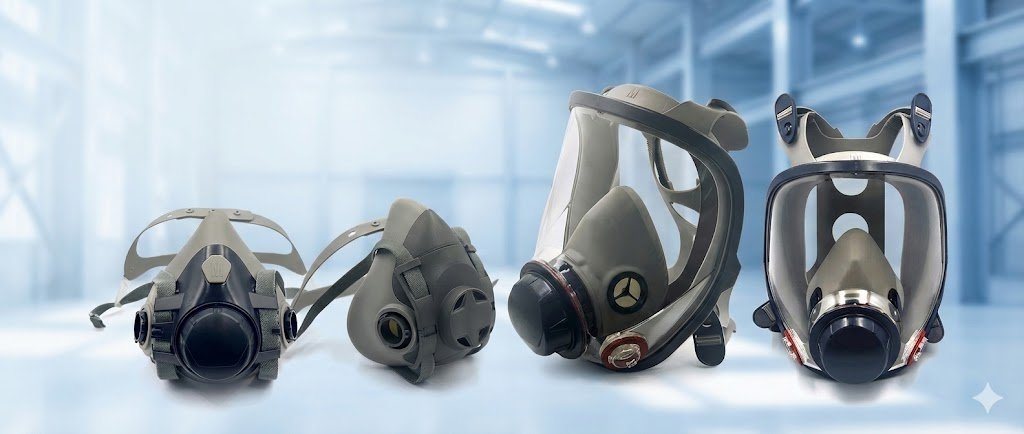
1. When to Choose a Full-Facepiece Respirator (e.g., CoSafety DR800)
Full-face respirators are the “heavy-duty” option for high-risk environments. They provide a complete seal around the entire face, covering the eyes, nose, and mouth.
Key Advantages:
- Integrated Eye Protection: Ideal for environments with chemical splashes, irritating gases, or flying debris. You don’t need separate safety goggles.
- Higher Protection Factor (APF): Due to the more secure seal, full-face masks generally offer a higher Assigned Protection Factor than half-mask versions.
- Secure Seal for Sensitive Tasks: Often used in laboratories or hazardous waste handling where zero exposure is the goal.
Best For:
Chemical processing, pesticide spraying, heavy-duty sanding, and emergency response.
2. When to Choose a Half-Facepiece Respirator (e.g., CoSafety DR300 AND DR600)
Half-face masks are the “workhorses” of the construction and manufacturing industries. They are lightweight and cover only the nose and mouth.
Key Advantages:
- Unmatched Ergonomics: Weighing significantly less than full-face models, they reduce neck fatigue during 8-hour shifts.
- PPE Compatibility: They work seamlessly with other gear, such as ou Bluetooth Earmuffs and safety helmets.
- Cost-Effective for Bulk Deployment: For large-scale workforces in lower-risk environments, half-face masks offer the best ROI for wholesale buyers.
Best For:
Construction, woodworking, warehouse logistics, and painting.
3. Comparison Table: At a Glance
| Feature | Full-Face Respirator | Half-Face Respirator |
|---|---|---|
| Eye Protection | Integrated | Requires Separate Goggles |
| Protection Level | Higher APF | Standard APF |
| Weight | Moderate to Heavy | Lightweight |
| Field of Vision | Wide Panoramic View | Standard |
| Primary Cost | Higher | Budget-Friendly |
| Filter Compatibility | Universal | Universal |
4. How do I know what respirator cartridge to use?
Selecting the correct respirator cartridge is the difference between complete safety and dangerous exposure. For safety officers and PPE distributors, understanding the “language” of cartridges is essential for ensuring workplace compliance. At CoSafety, we produce a wide range of universal bayonet cartridges. In this guide, we will simplify the selection process by explaining hazard types, color codes, and replacement schedules.
Step 1: Identify the Hazard Type
Before selecting a cartridge, you must determine what is in the air. Respiratory hazards generally fall into two categories:
- Particulates (Dust, Mists, Fumes): Requires a Particulate Filter (e.g., N95, P100, or FFP3). These use physical fibers to trap solid or liquid particles.
- Gases and Vapors (Chemicals, Smells): Requires a Chemical Cartridge. These use activated carbon to chemically “adsorb” molecules from the air.
Note: Many environments require a Combination Cartridge that handles both particulates and gases.
Step 2: Decipher the Color Coding System
To make selection easier, international standards (NIOSH in the US and CE in Europe) use a universal color-coding system. Here is a breakdown of the most common CoSafety cartridge colors:
NIOSH (US Standard) Color Codes:
- Black: Organic Vapors (Solvents, degreasers, paint thinners).
- White: Acid Gases (Chlorine, hydrogen chloride, sulfur dioxide).
- Yellow: Organic Vapors + Acid Gases.
- Green: Ammonia or Methylamine.
- Purple/Magenta: P100 Particulates (99.97% filtration of all aerosols).
CE (EU Standard) Color Codes:
- Brown (A): Organic Vapors (boiling point > 65°C).
- Grey (B): Inorganic Gases.
- Yellow (E): Acid Gases.
- Green (K): Ammonia and derivatives.
Step 3: Check for Compatibility and Fit
A cartridge is only effective if it fits your mask perfectly.
- Universal Bayonet Connection: Most CoSafety masks and cartridges utilize a standard bayonet connection, ensuring they are compatible with other major industrial respirator brands.
- Dual vs. Single Cartridge: Half-face masks usually use dual cartridges to balance weight and lower breathing resistance, while some heavy-duty full-face masks may use a single, large canister.
Step 4: When Should You Change the Cartridge?
This is the most frequent question from procurement managers. There are three key “change indicators”:
- Sense of Smell or Taste: If you can smell or taste the chemical inside the mask, the cartridge is “saturated” and must be replaced immediately.
- Breathing Resistance: For particulate filters, if it becomes difficult to breathe, the filter is clogged with dust.
- End-of-Service Life Indicator (ESLI): Some advanced cartridges have a visual change, but most rely on a pre-determined Change-out Schedule based on the concentration of the hazard.
The CoSafety Advantage: Reliability for Wholesale
As a factory-direct supplier, CoSafety ensures that every cartridge is tested under rigorous laboratory conditions.
- Premium Activated Carbon: We use high-iodine value coconut shell activated carbon for superior adsorption capacity.
- Strict QC: Every batch is tested for airflow resistance and filtration efficiency.
- Bulk Availability: We maintain a steady stock of P100 and ABEK1 cartridges to support our global distributors in the USA, EU, and Middle East.
5. The “CoSafety Advantage”: Why Wholesale Buyers Trust Us
When sourcing respirators from China, quality and compliance are the top priorities. At CoSafety, we bridge the gap between “factory pricing” and “global standards.”
- Certified Excellence: Our manufacturing processes are ISO 9001 certified, and our respirators are designed to meet CE (EN 140/136) and ANSI standards.
- Premium Silicone Material: We use medical-grade silicone instead of cheap PVC, ensuring the mask remains soft and skin-friendly even in extreme temperatures.
- Factory-Direct Wholesale: By eliminating middlemen, we provide distributors in the USA, EU, and Africa with the most competitive margins.
6. Frequently Asked Questions
Q1: Can I use the same filters for both full-face and half-face masks?
Answer: In the CoSafety ecosystem, yes. We utilize a Universal Bayonet Connection that allows our P100 particle filters and ABEK1 gas cartridges to be used across our entire respirator range, simplifying your inventory management.
Q2: How often should the respirator body be replaced?
Answer: While filters are replaced frequently, a high-quality silicone mask body from a reliable factory can last 2-3 years if maintained correctly. We recommend daily cleaning and inspection of the exhalation valve.
Q3: Do you support OEM branding for large orders?
Answer: Yes. As a dedicated PPE factory, we offer full OEM/ODM services, including custom logo printing on the mask body and bespoke retail packaging for your local market.
7. Ready to Secure Your Workforce?
Choosing the right respiratory protection is about balancing safety, comfort, and compliance. Whether you need a 24-hour quote for a massive construction project or a sample for fit-testing, our team is ready to assist.
Contact Iris Han today at irishan@zmsafety.cn or send us a whatsapp.
Keywords: Wholesale Respirator, Respirator Factory China, Full Face vs Half Face Mask, PPE Procurement, Industrial Safety Supplier.