
In high-noise environments, the physiological threat of noise-induced hearing loss (NIHL) is a permanent and irreversible risk. Human hearing is susceptible to damage when exposed to sound pressure levels exceeding 85 decibels for prolonged durations, or even instantaneous exposure to impulsive sounds exceeding 140 decibels. Historically, the trade-off in hearing protection was between attenuation and communication; the more effectively a device blocked noise, the more it isolated the user from critical environmental cues and verbal commands. To mitigate these risks, the development of personal protective equipment (PPE) has moved toward devices that not only attenuate harmful sound but also facilitate essential communication and situational awareness.
By utilizing external microphones and internal processing units, modern earmuffs like Cosafety’s EM009 / EM011 can selectively filter the auditory environment—compressing dangerous impulse noises while amplifying the frequencies associated with human speech.

How do bluetooth earmuffs work?
The physical construction of a hearing protector is the first line of defense against acoustic energy. Both CoSafety‘s EM009 and EM011 utilize a high-density Acrylonitrile Butadiene Styrene (ABS) cup design, which serves as a robust housing for the internal electronic components and the acoustic dampening materials. ABS is a thermoplastic polymer favored in the PPE industry for its high impact resistance, rigidity, and thermal stability.
The interface between the device and the wearer’s skull is the most critical component for maintaining an effective acoustic seal. Both models are equipped with PU foam cushions. Polyurethane (PU) foam is a viscoelastic material that exhibits unique deformation characteristics, allowing it to conform to the irregular contours of the mastoid process and the areas surrounding the pinna. The importance of this seal cannot be overstated; even a minor gap can lead to “acoustic leakage,” which drastically reduces the effective Single Number Rating (SNR) of the device.
what are the advantages?:
Material Science and Ergonomic Engineering
| Material Property | ABS Cup Specification | PU Foam Cushion Specification |
| Structural Rigidity | High (Resistance to deformation) | Low (Conformable) |
| Impact Resistance | Measured via 1-meter drop test | High energy absorption |
| Thermal Stability | Resistance to 650$ (Ignitability) | Stable under body heat conditions |
| Skin Compatibility | Non-staining, non-irritating | Hypoallergenic imitation leather cover |
| Weight Efficiency | Lightweight thermoplastic | Low-density foam |
The ergonomic design of these earmuffs incorporates a wide, padded headband that distributes the clamping force across the vertex of the head. This clamping force, measured in Newtons (N) according to EN 352-1, is calibrated to provide enough pressure to maintain a seal without causing the “clamping fatigue” often associated with lower-quality industrial earmuffs. The 360-degree rotatable ear cups further enhance this fit, ensuring that the device can accommodate a wide variance in head shapes and sizes, which is essential for workforce-wide compliance programs
Acoustic Performance Analysis SNR NRR and Sound Pressure Dynamics
The primary metric for evaluating a hearing protector’s effectiveness is its attenuation rating. The EM009 and EM011 are rated using the European Single Number Rating (SNR) and the North American Noise Reduction Rating (NRR). While both serve similar purposes, the SNR is often considered a more comprehensive metric for the European market, as it accounts for the device’s performance across low, medium, and high frequencies.
For the EM011, which boasts an SNR of 30dB, an ambient environment of 110dB is reduced to 80dB at the ear canal, bringing the noise level well within the OSHA-recommended exposure limit of 85dB.
Comparative Acoustic Performance Matrix
The table below provides a side-by-side comparison of the acoustic and electronic profiles of both products, highlighting the specific advantages of each architecture.
| Feature | EM009 Tactical Series | EM011 Endurance |
| SNR (Single Number Rating) | 29 dB | 30 dB |
| Sound Reduction Type | Active Digital Compression | Passive Barrier + Bluetooth |
| Volume Limiter | Yes (Max 85dB) | Yes (Max 85dB) |
| Audio Input | 3.5mm AUX | 3.5mm AUX |
Ear Muff’s active listening capability is governed by EN 352-4, which ensures that the level-dependent function works reliably. This device employs a digital compression circuit that actively monitors the environment. When the sound pressure level reaches 82dB, the circuit triggers a gain reduction, compressing the audio signal to prevent it from reaching unsafe levels. Conversely, the device amplifies safe ambient sounds, such as speech or warning signals, ensuring that the user remains connected to their surroundings even in loud environments.
Electronic Intelligence Active Sound Compression and Signal Restoration in the Bluetooth Hearing Protective Earmuffs
CoSafety’s earmuffs are classified as a “smart” hearing protector due to its active signal processing capabilities. They are particularly suited for environments with impulsive noise, such as shooting ranges, construction sites with pneumatic tools, or industrial forging.
The active listening technology operates on a sophisticated feedback loop. External omnidirectional microphones capture environmental noise and feed it into a digital signal processor (DSP). The DSP performs several functions:
- Noise Threshold Monitoring: The processor calculates the RMS energy of the incoming sound wave.
- Fast Attack Time Compression: If the incoming sound (such as a gunshot) exceeds $82\text{ dB}$, the processor reduces the gain of the internal speakers in less than 0.005 seconds (5 milliseconds). This speed is crucial for protecting the ear from the rapid pressure rise of an impulse noise.
- Signal Restoration: Once the loud noise subsides, the gain is restored instantly, allowing for continuous conversation without the “pumping” or “choppy” sound characteristic of older analog systems.
- Ambient Amplification: For sounds below the safety threshold, they can provide up to 5 times amplification, allowing users to hear subtle environmental cues better than they could with the naked ear.
This combination of protection and enhancement is the hallmark of tactical-grade PPE. It addresses the primary reason for non-compliance in the workplace: the feeling of isolation and the inability to communicate while wearing earmuffs.
The Bluetooth 5.1 Revolution Comparative Analysis of Wireless Infrastructure in the EM011
While the EM009 focuses on active situational awareness, the EM011 is a showcase for the latest in wireless connectivity and power efficiency. The transition from Bluetooth 5.0 to 5.1 in the EM011 represents a significant technological leap that impacts connection stability, pairing speed, and battery longevity.
Bluetooth 5.1 Technical Advantages
| Connectivity Spec | EM009 (Bluetooth 5.0) | EM011 (Bluetooth 5.1) |
| Handshake Speed | Standard | Accelerated (GATT Caching) |
| Interference Resistance | High | Ultra-High (Randomized Indexing) |
| Transmission Efficiency | High | Optimized for LE (Low Energy) |
| Max Transmission Range | ≥ 10 meters | ≥ 10 meters |
| Audio Quality | Stereo High-Fidelity | High-Resolution AptX Support |
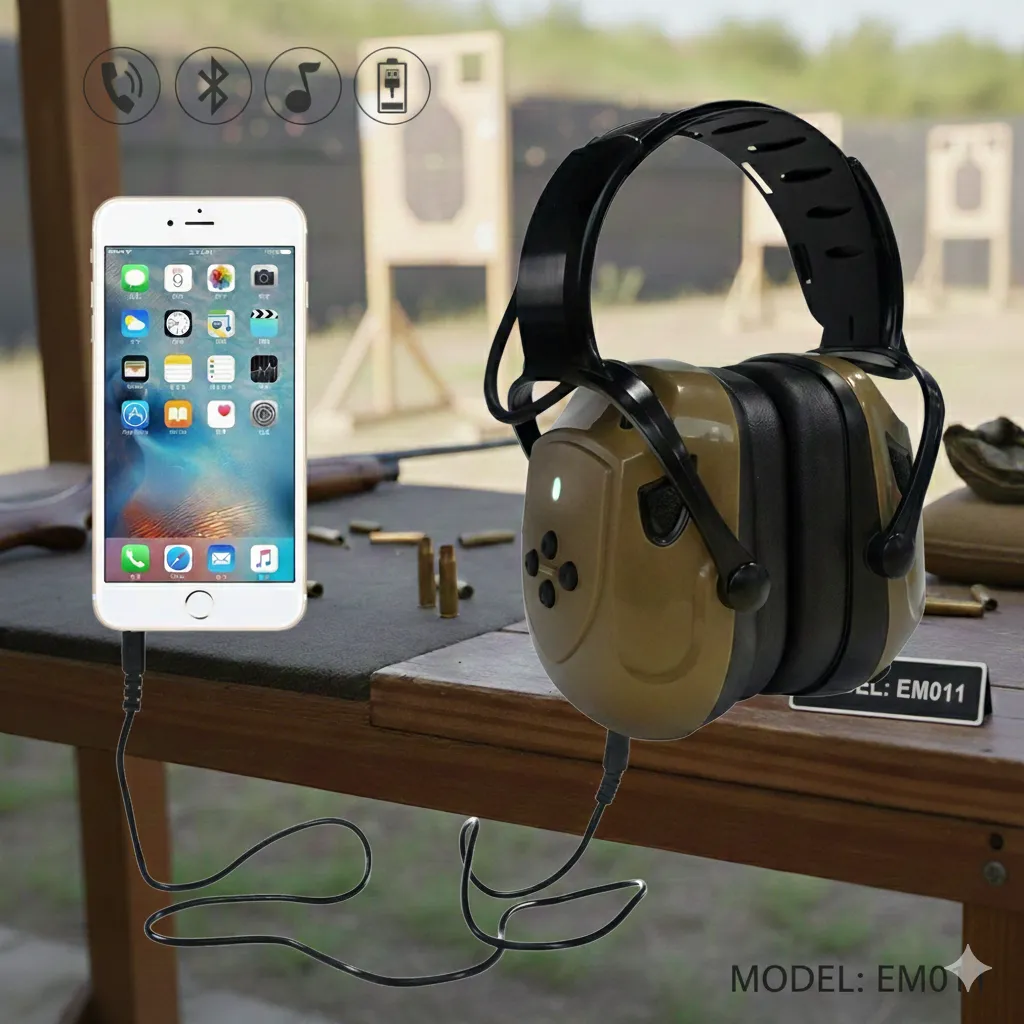
CoSafety provides more than just multifunctional bluetooth earmuffs; it offers a new standard in hearing protection and communication solutions.
Ready to Secure Your Workforce?
Contact Iris Han today at irishan@zmsafety.cn or send us a whatsapp